One Execution Layer. Every Commerce Channel. Unified Version of Revenue Truth.
Most enterprises don't run one commerce platform — they run three. Consolidating execution across SAP, Oracle, and in-house systems isn't a data problem. It's an execution problem. Here's how viax solves it.

The reality of enterprise commerce today
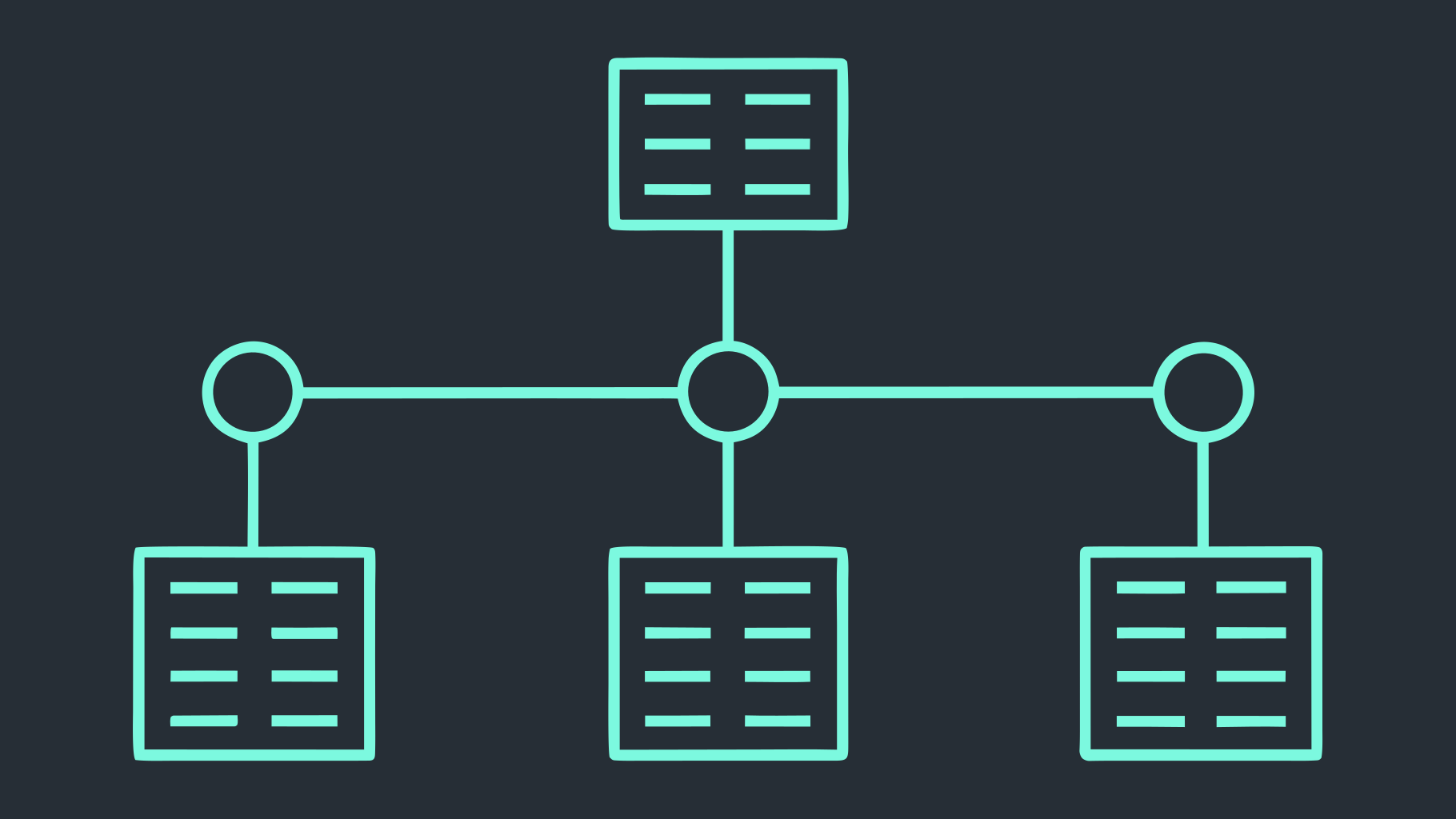
Enterprise revenue doesn't flow through one system. It flows through many — ERPs, commerce platforms, in-house solutions built over years to fill gaps that no single vendor could address. Each system owns a piece of execution. None of them agree.
Pricing logic lives in multiple places, applied inconsistently. Commercial flows require manual reconciliation across teams. Every time the business wants to move — a new pricing motion, a bundle, a changed discount rule — the effort multiplies across every platform involved. The more systems, the more friction. The more friction, the slower revenue moves.
This isn't an integration problem that better APIs will fix. It's a structural one. Execution is distributed across systems that were never designed to share a single version of commercial truth.
"Execution is trapped inside systems that weren't designed to talk to each other — and every change adds risk."
Consolidation doesn't mean rip-and-replace
The instinct is to solve this with a migration — pick a winner, sunset the others, and force a hard cut-over. But SAP handles certain workflows, Oracle owns others, and the in-house system exists because neither could do what the business actually needed. Ripping out any one of them is a program-level commitment. Ripping out all three isn't a plan — it's a risk.
viax takes a different path. Rather than replacing your commerce platforms, viax sits above them — establishing a unified revenue execution layer that defines how pricing, logic, and commercial flows behave, then deploys that behavior consistently across every system below it.
Your existing systems remain intact. Your teams keep operating in the interfaces they know. Consolidation happens incrementally, on your timeline — one execution motion at a time. Nothing is rebuilt. Nothing is discarded. Each capability built on the platform becomes the foundation for the next.
"Built to evolve — not restart. Consolidation at your pace, not the pace of a transformation program."
Model once. Execute across every channel.
The deeper problem with a fragmented commerce stack isn't just that systems disagree — it's that every complex capability has to be rebuilt in each one. Subscription logic modeled in SAP gets re-implemented in Oracle. Bundle rules configured for one channel don't carry to the next. Approval workflows are duplicated, diverge over time, and eventually contradict each other.
viax breaks that pattern. Complex revenue capabilities — pricing models, entitlement rules, subscription structures, approval flows, product configurations — are modeled once inside the viax execution layer. From there, they execute transparently across every channel, system, and interface the business operates.
The model doesn't change based on where execution happens. A subscription structure defined in viax behaves identically whether it's surfaced through a direct sales channel, a self-serve portal, or a partner commerce flow. The channel defines the interface. viax defines the logic.
"Model real-world revenue complexity once. Execute everywhere. Nothing rebuilt. Nothing discarded."
Unify pricing without touching your ERPs
Pricing inconsistency across platforms is one of the most common and costly symptoms of a fragmented commerce stack. A price defined in SAP may differ from what Oracle calculates, which may differ still from what the in-house system surfaces. The downstream effects — incorrect invoicing, revenue leakage, sales team confusion — compound quickly.
viax's pricing engine models and deploys commercial logic at the execution layer. Define a pricing rule once. It applies transparently across every channel, system, and customer touchpoint — without requiring changes to the underlying ERP configuration.
"Rules defined once influence what happens. Systems and interfaces define how it happens."
Execute complex flows, over time, at your pace
Revenue execution isn't a single event — it's a continuous process of change. New commercial models. Acquisitions that bring new systems into the stack. Divestitures that require carving out execution cleanly. Subscription transitions layered onto transactional infrastructure that was never designed to support them.
viax is built to evolve with the business, not restart every time it changes. Execution models aren't discarded when the business changes direction — they're extended. Each capability built on the platform becomes the foundation for the next. Consolidation happens incrementally, on your timeline, without forcing a rip-and-replace decision on any single system.
Generate UI without rebuilding every interface
One of the quietest costs in a multi-platform stack is interface fragmentation. Sales teams learn different tools. Quoting happens in different places. The customer experience diverges based on which backend happens to be handling the transaction.
viax's UI generation capability allows commercial interfaces — quoting screens, configurators, pricing displays — to be generated directly from the execution model. The logic is consistent because it comes from a single source. The interface can be deployed wherever it's needed, independent of which underlying system handles fulfillment.
Start anywhere. Consolidate everything.
The path forward doesn't start with a migration plan. It starts with a simpler question: where is execution causing the most friction today? A pricing inconsistency between platforms. A commercial flow that requires three teams to coordinate a change. A quoting interface that doesn't reflect current pricing logic.
viax lets you start there. Prove execution in a specific motion — without modifying ERP, without waiting on transformation timelines. Then extend. Consolidation isn't a big-bang program. It's a series of execution decisions, each one building on the last.
While your ERP teams handle system stability, your revenue team moves at the speed the business requires.
The reality of enterprise commerce today
Enterprise revenue doesn't flow through one system. It flows through many — ERPs, commerce platforms, in-house solutions built over years to fill gaps that no single vendor could address. Each system owns a piece of execution. None of them agree.
Pricing logic lives in multiple places, applied inconsistently. Commercial flows require manual reconciliation across teams. Every time the business wants to move — a new pricing motion, a bundle, a changed discount rule — the effort multiplies across every platform involved. The more systems, the more friction. The more friction, the slower revenue moves.
This isn't an integration problem that better APIs will fix. It's a structural one. Execution is distributed across systems that were never designed to share a single version of commercial truth.
"Execution is trapped inside systems that weren't designed to talk to each other — and every change adds risk."
Consolidation doesn't mean rip-and-replace
The instinct is to solve this with a migration — pick a winner, sunset the others, and force a hard cut-over. But SAP handles certain workflows, Oracle owns others, and the in-house system exists because neither could do what the business actually needed. Ripping out any one of them is a program-level commitment. Ripping out all three isn't a plan — it's a risk.
viax takes a different path. Rather than replacing your commerce platforms, viax sits above them — establishing a unified revenue execution layer that defines how pricing, logic, and commercial flows behave, then deploys that behavior consistently across every system below it.
Your existing systems remain intact. Your teams keep operating in the interfaces they know. Consolidation happens incrementally, on your timeline — one execution motion at a time. Nothing is rebuilt. Nothing is discarded. Each capability built on the platform becomes the foundation for the next.
"Built to evolve — not restart. Consolidation at your pace, not the pace of a transformation program."
Model once. Execute across every channel.
The deeper problem with a fragmented commerce stack isn't just that systems disagree — it's that every complex capability has to be rebuilt in each one. Subscription logic modeled in SAP gets re-implemented in Oracle. Bundle rules configured for one channel don't carry to the next. Approval workflows are duplicated, diverge over time, and eventually contradict each other.
viax breaks that pattern. Complex revenue capabilities — pricing models, entitlement rules, subscription structures, approval flows, product configurations — are modeled once inside the viax execution layer. From there, they execute transparently across every channel, system, and interface the business operates.
The model doesn't change based on where execution happens. A subscription structure defined in viax behaves identically whether it's surfaced through a direct sales channel, a self-serve portal, or a partner commerce flow. The channel defines the interface. viax defines the logic.
"Model real-world revenue complexity once. Execute everywhere. Nothing rebuilt. Nothing discarded."
Unify pricing without touching your ERPs
Pricing inconsistency across platforms is one of the most common and costly symptoms of a fragmented commerce stack. A price defined in SAP may differ from what Oracle calculates, which may differ still from what the in-house system surfaces. The downstream effects — incorrect invoicing, revenue leakage, sales team confusion — compound quickly.
viax's pricing engine models and deploys commercial logic at the execution layer. Define a pricing rule once. It applies transparently across every channel, system, and customer touchpoint — without requiring changes to the underlying ERP configuration.
"Rules defined once influence what happens. Systems and interfaces define how it happens."
Execute complex flows, over time, at your pace
Revenue execution isn't a single event — it's a continuous process of change. New commercial models. Acquisitions that bring new systems into the stack. Divestitures that require carving out execution cleanly. Subscription transitions layered onto transactional infrastructure that was never designed to support them.
viax is built to evolve with the business, not restart every time it changes. Execution models aren't discarded when the business changes direction — they're extended. Each capability built on the platform becomes the foundation for the next. Consolidation happens incrementally, on your timeline, without forcing a rip-and-replace decision on any single system.
Generate UI without rebuilding every interface
One of the quietest costs in a multi-platform stack is interface fragmentation. Sales teams learn different tools. Quoting happens in different places. The customer experience diverges based on which backend happens to be handling the transaction.
viax's UI generation capability allows commercial interfaces — quoting screens, configurators, pricing displays — to be generated directly from the execution model. The logic is consistent because it comes from a single source. The interface can be deployed wherever it's needed, independent of which underlying system handles fulfillment.
Start anywhere. Consolidate everything.
The path forward doesn't start with a migration plan. It starts with a simpler question: where is execution causing the most friction today? A pricing inconsistency between platforms. A commercial flow that requires three teams to coordinate a change. A quoting interface that doesn't reflect current pricing logic.
viax lets you start there. Prove execution in a specific motion — without modifying ERP, without waiting on transformation timelines. Then extend. Consolidation isn't a big-bang program. It's a series of execution decisions, each one building on the last.
While your ERP teams handle system stability, your revenue team moves at the speed the business requires.
Next Resource
About viax
viax is the revenue execution layer for enterprises navigating complex systems and constant change. We help organizations separate revenue logic from systems of record so they can modernize customer-facing processes, extend legacy ERP investments, and simplify future migrations—without disrupting the business.
Execute revenue change with confidence.
Explore how revenue execution works across real enterprise environments.
See viax in action
Execute revenue change with confidence.
Explore how revenue execution works across real enterprise environments.
See viax in action